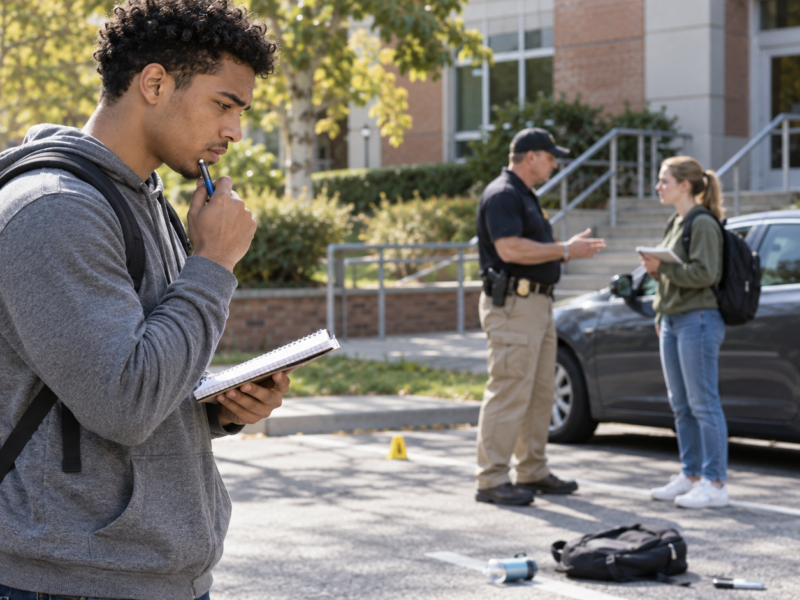
A criminal justice student reviews a fictional burglary investigation. Near a damaged rear door, officers have photographed a red glove. The store owner says the glove does not belong to anyone who works there.
The student points to the photograph and says, “That’s evidence.”
The instructor asks a follow-up question:
“Evidence of what?”
The room grows quiet.
The student has identified an item that may deserve attention. But explaining its possible significance requires another step: connecting it to a question in the investigation, and recognizing what it cannot establish on its own.
Finding is only the beginning
The glove’s location may help investigators explore whether someone approached or entered through the rear door. It may also have an innocent explanation. Perhaps it belonged to a delivery driver or had been there before the reported break-in.
The photograph alone does not tell the student who wore the glove, when it was left, or whether it is connected to the burglary.
Those uncertainties do not make the glove unimportant. They give the student a reason to ask better questions.
Federal Rule of Evidence 401 offers a useful classroom principle: evidence is relevant when it tends to make a consequential fact more or less probable. Whether evidence is ultimately admissible depends on additional rules and the case’s circumstances (Fed. R. Evid. 401).
From identification to explanation
An instructor could ask students to write a short response to four questions:
- What was found, and where?
- What question might it help answer?
- What does it not establish by itself?
- What additional information would help evaluate its significance?
A thoughtful answer might state:
“The glove was photographed near the damaged rear door. Its location may help explain who approached that area, but the available facts do not establish who left it or when. Further investigation could help determine whether it is connected to the reported burglary.”
This response describes the observation, suggests a possible connection, and acknowledges its limits.
A skill students can practice
Research-based educational guidance encourages instructors to ask students explanatory questions that require them to connect ideas and support their reasoning (Pashler et al., 2007). A fictional investigation offers one way to apply that approach in a criminal justice classroom.
Finding an item is a beginning. Explaining why it might matter, and what remains uncertain, helps students practice the careful reasoning behind a stronger investigation.
Explore a fictional scenario at KLYVOREK Institute and practice making your case.
References
Federal Rule of Evidence 401. https://www.law.cornell.edu/rules/fre/rule_401.
Pashler, H., Bain, P. M., Bottge, B. A., Graesser, A., Koedinger, K., McDaniel, M., & Metcalfe, J. (2007). Organizing instruction and study to improve student learning. National Center for Education Research, Institute of Education Sciences, U.S. Department of Education. https://ies.ed.gov/ncee/wwc/PracticeGuide/1.