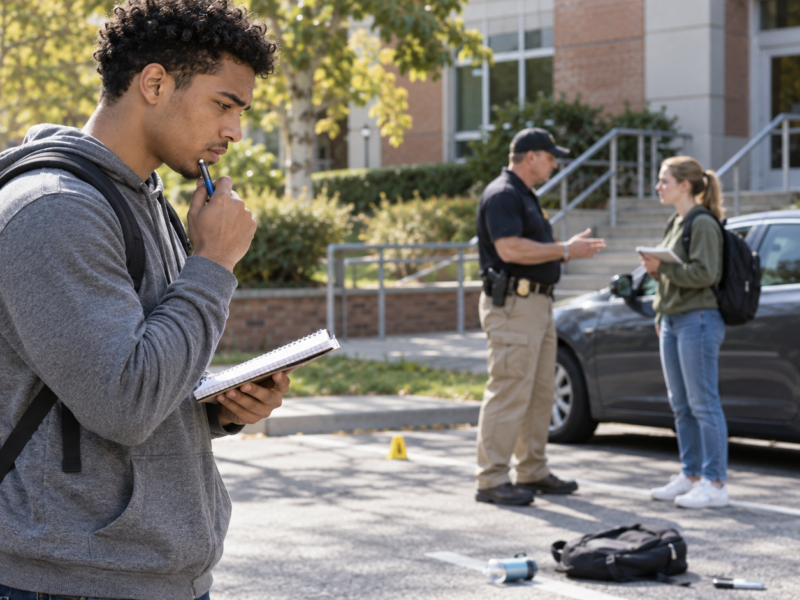
Someone says they couldn’t have committed the crime because they were somewhere else.
That sounds simple.
It rarely is.
For criminal justice students, an alibi is a useful way to learn one of the most important habits in investigative thinking:
Do not confuse a convincing story with a verified timeline.
Imagine a robbery occurred between 7:20 and 7:40 p.m.
A person of interest says:
“I left work at 6:45, grabbed food, stopped at a friend’s house, and was home before 8:00.”
Your job is not to decide immediately whether the person is truthful.
Your job is to test the timeline.
Start by breaking the story into separate events:
6:45 p.m. — Leaves work
7:00 p.m. — Buys food
7:20 p.m. — Arrives at friend’s house
7:50 p.m. — Leaves
8:00 p.m. — Arrives home
Now ask:
- What supports each point?
- Who can verify it?
- What records may exist?
- Does the travel time make sense?
- Are there gaps?
- Do any sources conflict?
This is where a classroom exercise becomes investigative reasoning.
A statement is not automatically a fact.
A witness is not automatically correct.
A timestamp is not automatically conclusive.
And an inconsistency does not automatically mean deception.
Good investigators learn to separate information into categories:
- Claimed — what someone says happened.
- Corroborated — supported by independent information.
- Contradicted — inconsistent with reliable evidence.
- Unresolved — not enough information exists yet.
That last category is especially important.
Students often feel pressure to reach a conclusion because a scenario appears to demand one.
Real investigations do not always cooperate.
Sometimes the correct answer is: The evidence is incomplete.
That is not failure.
That is disciplined reasoning.
The strongest criminal justice students learn to resist the temptation to make the facts fit a preferred theory.
Instead, they let the evidence shape the conclusion.
An alibi timeline is therefore more than a chart of times and places.
It is a test of whether you can distinguish: what was said, what can be supported, what conflicts, and what remains unknown.
That is the real skill.
Not solving the case quickly.
Solving it carefully.
Follow the facts. Test the timeline. Make your case.
Klyvorek & OpenAI